What is whole-body cryotherapy, and what does the research show?
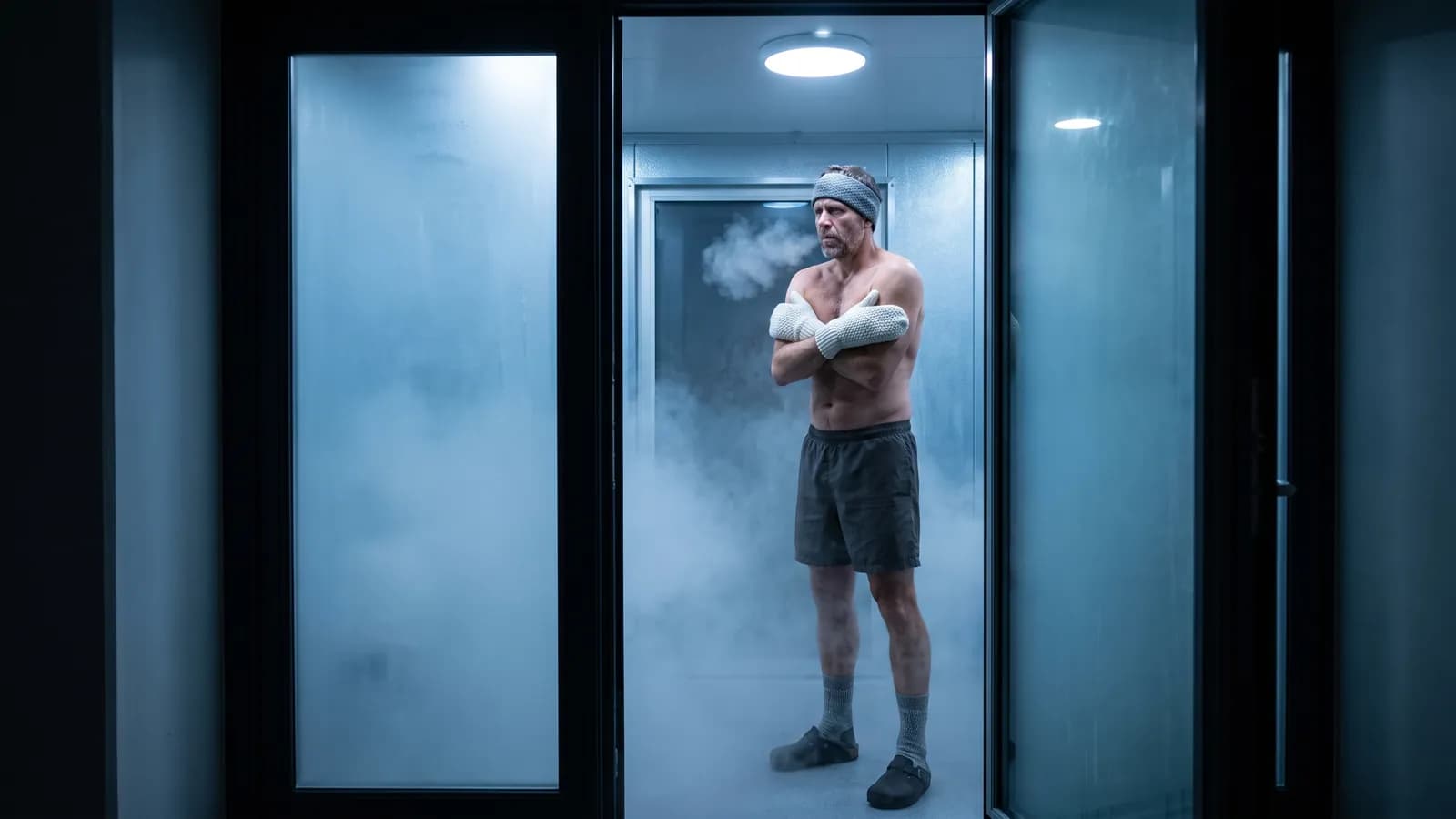
Whole-body cryotherapy means standing briefly in a one-person cabin cooled by nitrogen vapor, sometimes called a "cryosauna," or in a walk-in chamber cooled by nitrogen or cold air. The trials of muscle recovery, pain relief and mood that we read were small or short. We found no FDA clearance for whole-body cryotherapy chambers as of September 28, 2026.
Overview
Whole-body cryotherapy means standing briefly in a chamber or one-person cabin cooled by nitrogen vapor or cold air. In searches of Europe PMC, PubMed and ClinicalTrials.gov on October 1, 2026, we found no trial in people showing that whole-body cryotherapy slows aging, and the small controlled trials we read did not show that it helps people lose weight.
Why People Use It
We found no FDA clearance for whole-body cryotherapy chambers for any use, including exercise recovery, pain, weight loss or healthy aging as of September 28, 2026.
Spas, gyms and clinics offer whole-body cryotherapy for exercise recovery, muscle and joint pain, mood support and weight management, and the strength of the evidence differs by use.
Evidence
| What people use it for | Population studied | Evidence level | Best source |
|---|---|---|---|
| Muscle recovery after exercise | Mostly young, physically active men in lab exercise studies | Emerging (small trials; a Cochrane review rated it very low certainty) | Costello 2015 Cochrane review; Wu 2026 and Chen 2024 network meta-analyses |
| Inflammation markers | 274 people in 11 pooled trials: athletes, people with obesity and healthy adults | Emerging (mixed: 2 of 4 blood markers changed, 2 did not; small trials) | He 2025 meta-analysis of 11 randomized trials |
| Rheumatoid arthritis and fibromyalgia pain | Adults with diagnosed rheumatoid arthritis or fibromyalgia, some of them during an inpatient program | Emerging (small trials; none of those we read used a sham treatment) | Klemm 2022; Hirvonen 2006; Guillot 2014; Rivera 2018 and other small trials |
| Mood and depression | Adults with diagnosed depression already taking antidepressants | Emerging (a small sham-controlled trial plus a mixed meta-analysis, called preliminary) | Rymaszewska 2020; Doets 2021 meta-analysis |
| Weight and metabolism | 19 adults with obesity in a weight-loss program (controlled trial designed to test weight loss); 65 adults with overweight or obesity and 16 active men in training studies (randomized trials, body fat as a side result); 37 menopausal women (no untreated comparison group) | Evidence against (weight loss in adults with obesity in a weight-loss program; a controlled trial of 19 people, not strictly randomized, designed to test it); Emerging (blood lipids and fasting glucose, secondary results) | Karppinen 2025 controlled trial; Kozłowska-Flis 2021 and Haq 2022 randomized trials; Wiecek 2020 study with no untreated group |
| Slowing aging or extending lifespan | Not published | No trial found (lifespan, death from any cause, biological age, epigenetic age or telomere length in people; Europe PMC, PubMed and ClinicalTrials.gov searches, October 1, 2026) | Our Europe PMC, PubMed and ClinicalTrials.gov searches, October 1, 2026 |
Evidence levels in this table follow our grading key. Established means consistent results from randomized trials or a systematic review of them, or that a guideline, expert panel or government record says something. Emerging means some controlled human evidence that falls short of that, such as small or short trials, mixed results or trials funded by an operator. Evidence against means a controlled trial tested the claim as its main result in the people the cell names and did not find the effect, and our searches of Europe PMC, PubMed and ClinicalTrials.gov on October 1, 2026, found no controlled trial in those people that did. No trial found means the same searches, covering study titles and summaries, found no trial in people that measured the outcomes the cell names. In this table, Not published means our searches of Europe PMC and PubMed on October 1, 2026, covering study titles and summaries, found no published study in people that measured lifespan, death from any cause, biological age, epigenetic age or telomere length after whole-body cryotherapy, so there is no study population to report.
Muscle soreness and exercise recovery
We found no FDA clearance for whole-body cryotherapy chambers for any use, including exercise recovery, pain, weight loss or healthy aging as of September 28, 2026.
In small studies of young, active adults, mostly men, whole-body cryotherapy after hard exercise sometimes lowered soreness or helped muscles recover; a 2015 Cochrane review rated this evidence very low certainty and said it was not enough to know whether it reduces soreness. All but four of that review's 64 participants were men, and its authors wrote that there was no evidence on its use in women or elite athletes.
A 2015 Cochrane review of 4 small lab trials (64 physically active, mostly young adults) found lower self-reported muscle soreness one hour after whole-body cryotherapy than after rest or no cryotherapy, a result from 20 participants in two of the trials; the differences at 24 to 72 hours could have been due to chance. The review rated all of its evidence very low certainty and said there was not enough evidence to know whether whole-body cryotherapy reduces soreness.[1] A 2026 network meta-analysis of 51 trials (1,243 people) found that no form of cryotherapy, including whole-body cryotherapy, significantly reduced muscle soreness right after exercise.[2] The same network meta-analysis found better jump performance with whole-body cryotherapy than with a control condition at 1, 24 and 48 hours after exercise, and lower blood levels of creatine kinase at 48 and 72 hours and of CRP at 48 hours (markers of muscle damage and inflammation); the CRP difference was not significant at 72 hours.[2] A separate 2024 ranking analysis of 57 studies (1,220 healthy people) ranked cryotherapy highest of four treatments for relieving delayed-onset muscle soreness. A ranking score is not the same as an effect size, and the cryotherapy group combined whole-body, partial-body and air-pulse cryotherapy, so the result is not specific to whole-body cryotherapy.[3]
Versus ice baths and cold plunges
A 2012 Cochrane review of 17 small trials (366 people) found some evidence that cold-water immersion, which means sitting or standing in cold water and is a different treatment from whole-body cryotherapy, reduced muscle soreness after exercise compared with rest or no treatment; it rated the quality of the trials as low.[4]
Cold-water immersion and whole-body cryotherapy are different treatments: immersion is cold water on the skin, and cryotherapy is brief exposure to very cold dry air or nitrogen vapor. A Cochrane review of whole-body cryotherapy that searched to August 2015 found no trial that directly compared it with cold-water immersion; trials comparing the two have been published since.[1][5][6]
Small randomized trials have compared the two directly, including two whose published summaries we read. In 10 physically active men, the authors concluded that cold-water immersion was followed by lower soreness one to two days after exercise, and by faster recovery of jump performance at three days, than whole-body cryotherapy. In 31 endurance-trained men after a marathon, the authors reported that whole-body cryotherapy had a negative effect on muscle function and soreness compared with cold-water immersion, and concluded that cryotherapy was no more effective than a placebo treatment for recovery of function.[5][6]
A 2026 meta-analysis that set out to compare the two pooled 13 small randomized trials (214 people), not all of which tested both treatments, and found that cold-water immersion gave better next-day muscle-soreness relief than cryotherapy, while cryotherapy gave a small edge in next-day jump performance that the study authors called "small and fragile."[7]
Weight and metabolism
We found no FDA clearance for whole-body cryotherapy chambers for any use, including exercise recovery, pain, weight loss or healthy aging as of September 28, 2026.
In a controlled trial designed to test weight loss, 19 adults with obesity in a 12-month weight-loss program were assigned, without strict randomization, to the program with or without 28 whole-body cryotherapy sessions; adding cryotherapy did not increase weight loss (11.9% vs 11.5% at 5 months) or activate brown fat.[8] The same trial found no significant difference between the cryotherapy and non-cryotherapy groups in brown-fat activity or energy use, each measured during a cold test at 5 months, or in its analyses of fat tissue and muscle samples. The trial took no measurement at a comfortable temperature, so its authors could not separate resting energy use from the extra energy used in the cold.[8] Two other small randomized trials that we read measured body fat or body composition as a side result. In one, 65 inactive adults with overweight or obesity enrolled and were randomly assigned to two weeks of interval training alone (27 people) or the same training with 10 whole-body cryotherapy sessions (38 people), and the body-composition results cover all 65. Measured right after the two weeks, neither program had changed body composition, which included body fat, fat-free mass and skeletal muscle mass. The paper reports a follow-up four weeks later for the cryotherapy group only, with 35 of its 38 people in that analysis: skeletal muscle mass and fat-free mass were higher than at one of the group's other two measurements, before or right after the program (the paper does not say which; p = 0.01 for each), and with no training-only comparison at that point the change cannot be credited to cryotherapy. In 16 active men who completed a 6-week training program, body fat changed no differently with twice-weekly cryotherapy than without it.[9][10] Studies with no untreated comparison group have reported smaller waists or less body fat after a course of sessions, including one in 37 menopausal women, 19 of them with metabolic syndrome, who all had 20 sessions; without an untreated group, those changes cannot be credited to cryotherapy.[11] A 2020 meta-analysis of 7 studies found lower triglycerides after whole-body cryotherapy, with lower total and LDL cholesterol only in some further analyses; the 19-person controlled trial found lower LDL cholesterol at 5 months as a secondary result.[12][8] In the 19-person controlled trial, fasting blood sugar was lower at 5 months with cryotherapy, a secondary result the study authors said needs confirmation.[8]
Aging, longevity and skin
In searches of Europe PMC, PubMed and ClinicalTrials.gov on October 1, 2026, covering study titles and summaries, we found no study in people showing that whole-body cryotherapy slows aging or helps people live longer. In a 2026 study with no comparison group, 12 healthy women aged 21 to 25 had 10 whole-body cryotherapy sessions and showed no significant change in skin firmness or elasticity; skin hydration decreased and redness increased.[13] Other small studies have measured skin moisture, oil or water loss after whole-body cryotherapy, including one in 20 women with an average age of 59, in which skin hydration fell after ten treatment sessions; that study's published summary does not mention firmness or elasticity.[14]
Inflammation markers
We found no FDA clearance for whole-body cryotherapy chambers for any use, including exercise recovery, pain, weight loss or healthy aging as of September 28, 2026.
A 2025 meta-analysis of 11 randomized trials (274 people: athletes, people with obesity and healthy adults) found that whole-body cryotherapy lowered two of four pooled blood markers of inflammation (IL-1β and, in the opposite direction, IL-10 rose) but found no significant change in two others (IL-6 and TNF-α).[15] A change in a blood inflammation marker is a laboratory measurement, not proof of a health benefit; in searches of Europe PMC and PubMed on October 1, 2026, we found no trial testing whether whole-body cryotherapy prevents or treats any inflammation-related disease in healthy people. In a pilot study that followed 15 healthy adults using cryotherapy recreationally for about 9 months on average, having more sessions in the month before a blood test was linked to a slightly lower level of a blood marker called hsCRP; the study had no comparison group, so the difference cannot be credited to cryotherapy. Every author received salary support from Restore Hyper Wellness, a company that offers cryotherapy.[16]
Rheumatoid arthritis and fibromyalgia pain
We found no FDA clearance for whole-body cryotherapy chambers for any use, including exercise recovery, pain, weight loss or healthy aging as of September 28, 2026.
In a small randomized trial, 56 people with rheumatoid arthritis completed a 16-day multimodal rheumatology treatment program with or without 6 sessions of whole-body cryotherapy; pain fell more with cryotherapy, and in the cryotherapy group it was still below its starting level at 12 weeks. There was no sham treatment, so people knew whether they got cryotherapy.[17] A small randomized trial in 60 people with active rheumatoid arthritis compared whole-body cryotherapy with local cold air or cold packs, each added to physiotherapy for a week; pain fell most with whole-body cryotherapy at minus 110 degrees Celsius, but the authors concluded it was not superior to local cold treatment for pain relief.[18] The 2022 American College of Rheumatology guideline for rheumatoid arthritis conditionally recommends thermal treatments as a group, with cryotherapy, heat and therapeutic ultrasound given as examples, based on very low-certainty evidence; the recommendation covers the group and is not specific to whole-body cryotherapy.[19] An older pooled review of 6 studies (257 people with rheumatoid arthritis) found less pain after cryotherapy, but it combined local and whole-body cryotherapy together and did not separate the two.[20] In four small studies of people with fibromyalgia that we read, one of them only as a published summary, whole-body cryotherapy, usually added to other treatment, was followed by less pain, lower disease impact or better quality of life over the weeks studied. None compared it with a sham treatment, one used a cabin developed by a company in which one of the study's authors held stock, and one found no measurable benefit three months after treatment stopped. In searches of Europe PMC and PubMed on October 1, 2026, we found no systematic review devoted to whole-body cryotherapy for fibromyalgia.[21][22][23][24]
Mood and depression
We found no FDA clearance for whole-body cryotherapy chambers for any use, including exercise recovery, pain, weight loss or healthy aging as of September 28, 2026.
A sham-controlled trial enrolled 92 adults with a diagnosed depressive episode who were already taking antidepressants, and 56 of them completed it; adding 10 whole-body cryotherapy sessions improved depression-scale scores more than a less cold sham session on some measures. A separate 2021 meta-analysis of 10 studies, 6 of them controlled trials, covering 294 people who had cryotherapy, also favored cryotherapy, and its authors called the evidence preliminary.[25][26]
In a randomized study of 20 healthy young adults (average age 23), five consecutive days of whole-body cryotherapy were reported to improve mood and anxiety compared with five days without it; we read only the study's published summary, which gives no figures for mood.[27] We have not reviewed all the research on mood or well-being in healthy people without depression; the randomized study of 20 healthy young adults is one example from a Europe PMC search on October 1, 2026.
Risks and Side Effects
Published case reports describe serious events, including sudden temporary memory loss and a tear in the wall of a major artery; in searches of Europe PMC and PubMed on October 1, 2026, we found no study that measured how often they happen.
A 2023 scoping review found 16 documented adverse events after whole-body cryotherapy across 5 case reports and 2 randomized trials. It graded the events in four of the case reports as serious, including a torn wall of a major abdominal artery and sudden temporary memory loss. The events reported in the two trials were graded minor, among them hives in one participant, as was the fifth case report, a skin inflammation that improved within a couple of weeks after the man stopped the sessions; stopping was the only treatment he received.[28] A 2019 French national expert report, whose search of the published literature ran to December 2018, found that none of the randomized trials it included reported a serious adverse event, but noted that trials this small are not designed to detect rare harms, and it found no publication that reliably estimates how often complications occur.[29] The 2015 Cochrane review reported that none of its four trials actively tracked side effects. Among the other trials we read, a trial of 19 adults with obesity recorded no serious side effects and a few mild ones (evening coldness, headaches after early sessions and nasal numbness lasting up to a day), and a trial of 60 people with rheumatoid arthritis found no serious or lasting side effects, though 6 of the 40 people given whole-body cryotherapy (15%) stopped it.[1][8][18]
Nitrogen vapor and fainting risk
In a one-person cabin, nitrogen vapor is blown in directly and stays close to the body, below chin height; researchers who study cryotherapy safety have written that this free nitrogen vapor could be hazardous because it can displace the oxygen a person breathes.[30] This description comes from a research review, not from a trial that measured how often it happens; a walk-in chamber, where nitrogen or cold air runs through the walls rather than being blown directly into the space, is a different setup, and the two are not ranked against each other for safety here.
A safety guide for practitioners says it is mandatory to remove any sweat before a session to avoid the risk of skin burning.[30] A group of researchers who study cryotherapy wrote that, based on the case-level events they reviewed, safety risks are within acceptable limits when recommendations and contraindications are followed; the authors research cryotherapy themselves, and this is their own judgment, not a trial finding.[28]
Deaths
In 2015, according to Nevada's Division of Industrial Relations, an employee of a Nevada cryotherapy business died after entering a cryotherapy chamber for personal use after business hours.[31] The state's record does not give a cause of death.
If you have severe symptoms, call 911 or seek emergency care. Report side effects to FDA MedWatch.
Contraindication Considerations
The lists in this section come from four sources: an international research panel, a research review, a European consensus document as a French national report reproduces it, and one US state health department. They do not fully agree with each other, and this page does not present any of them as complete or official.
A 2025 systematic review and expert panel (28 specialists from 8 countries) listed temporary reasons to delay a session, including high or low blood pressure with signs of instability, acute illness, fever, pregnancy, severe anemia, claustrophobia and cold intolerance, and permanent reasons not to use it, including age over 80, heart disease, uncontrolled high blood pressure, a pacemaker or defibrillator, peripheral artery disease, a recent stroke, epilepsy, cold-related immune conditions, severe asthma or COPD, uncontrolled thyroid disease, uncontrolled diabetes, glaucoma and some cancers.[32] The panel who wrote this list study cryotherapy themselves, funded by Italy's health ministry; no conflicts were declared.
A 2017 research review listed a different but overlapping set of reasons not to use whole-body cryotherapy, including cold-triggered hives, cold intolerance, Raynaud's disease, thyroid conditions, acute breathing or heart conditions, open skin sores, nerve conditions, very low body weight, low body temperature, claustrophobia and conditions that make it hard to cooperate during treatment.[30] This list differs from the other lists on this page, for example on Raynaud's disease and thyroid conditions.
A national expert report, reproducing a 2006 European consensus document, listed 15 conditions that rule out whole-body cryotherapy altogether, including uncontrolled high blood pressure, a heart attack within six months, unstable angina, a pacemaker, a history of blood clots, an acute fever-causing respiratory infection, cold allergy, very low body weight, epilepsy and alcohol or drug addiction, plus 11 further conditions where a clinician should weigh the risk, including irregular heartbeat, valve disease, after heart surgery, Raynaud's syndrome, nerve disease and pregnancy from the fourth month.[29] The consensus document itself was not read directly; this is as an Inserm report describes it, and its authors and funders were not checked.
A 2015 guidance document from Nevada's state health department said whole-body cryotherapy machines should not be used by anyone under 18, should never be operated by a person on themselves, and should not be used more than once a day or for more than three minutes per session as a general standard; it also said a person with a recent heart attack or stroke, high blood pressure, pregnancy, a seizure disorder, Raynaud's, cold allergies, a clotting disorder, an infection or fever, a pacemaker or other implanted device, claustrophobia, or another serious medical condition should not use the machine, and it recommended checking blood pressure before and after each session.[33]
Anyone with a medical condition should ask a licensed clinician before trying whole-body cryotherapy.
Administration Methods
Whole-body cryotherapy is offered in two main setups: a one-person cabin, where nitrogen vapor is blown in directly around the body while the head stays outside the cold air, and a walk-in chamber, where the whole body is inside and cold nitrogen or air runs through the chamber walls. Researchers sometimes call the one-person cabin a "cryosauna" or "partial-body cryotherapy."[28][30]
Most of the trials described on this page used chamber temperatures between about minus 110 and minus 160 degrees Celsius, usually for 2 to 4 minutes per session, and one US state health department's 2015 guidance recommended sessions of no more than three minutes, once a day, as a general standard.[17][25][8][11][15][33] This page does not rank the two machine types against each other for safety: the description of nitrogen-related risk in the one-person cabin comes from a research review, not from a trial that compared it with a walk-in chamber.
Has FDA cleared any whole-body cryotherapy device?
We found no FDA clearance for whole-body cryotherapy chambers as of September 28, 2026.
Regulatory status checked September 28, 2026. Sources: web.archive.org/…/ucm508739.htm; www.accessdata.fda.gov/…/pmn.cfm; www.accessdata.fda.gov/…/denovo.cfm; www.accessdata.fda.gov/…/K203661.pdf; www.govinfo.gov/…/CFR-2025-title21-vol8-sec807-97.xml
Frequently Asked Questions
Does whole-body cryotherapy help muscle recovery after exercise?
In small studies of young, active adults, mostly men, whole-body cryotherapy after hard exercise sometimes lowered soreness or helped muscles recover; a 2015 Cochrane review rated this evidence very low certainty and said it was not enough to know whether it reduces soreness. All but four of that review's 64 participants were men, and its authors wrote that there was no evidence on its use in women or elite athletes.
We found no FDA clearance for whole-body cryotherapy chambers for any use, including exercise recovery, pain, weight loss or healthy aging as of September 28, 2026.
Is whole-body cryotherapy the same as an ice bath or cold plunge?
Cold-water immersion and cryotherapy are different treatments, and the research on one does not apply to the other. Pooled analyses that compare them do not all agree: a 2026 meta-analysis favored cold water for next-day soreness, while a 2024 ranking analysis placed a mixed group of cryotherapy types first for soreness.
Does cryotherapy help you lose weight or burn fat?
In a controlled trial designed to test weight loss, 19 adults with obesity in a 12-month weight-loss program were assigned, without strict randomization, to the program with or without 28 whole-body cryotherapy sessions; adding cryotherapy did not increase weight loss (11.9% vs 11.5% at 5 months) or activate brown fat. Two other small randomized trials that we read measured body fat or body composition as a side result. In one, 65 inactive adults with overweight or obesity enrolled and were randomly assigned to two weeks of interval training alone (27 people) or the same training with 10 whole-body cryotherapy sessions (38 people), and the body-composition results cover all 65. Measured right after the two weeks, neither program had changed body composition, which included body fat, fat-free mass and skeletal muscle mass. The paper reports a follow-up four weeks later for the cryotherapy group only, with 35 of its 38 people in that analysis: skeletal muscle mass and fat-free mass were higher than at one of the group's other two measurements, before or right after the program (the paper does not say which; p = 0.01 for each), and with no training-only comparison at that point the change cannot be credited to cryotherapy. In 16 active men who completed a 6-week training program, body fat changed no differently with twice-weekly cryotherapy than without it.
We found no FDA clearance for whole-body cryotherapy chambers for any use, including exercise recovery, pain, weight loss or healthy aging as of September 28, 2026.
Cryolipolysis, sometimes called "fat freezing," uses different equipment from whole-body cryotherapy and is not covered on this page.
Does whole-body cryotherapy slow aging?
In searches of Europe PMC, PubMed and ClinicalTrials.gov on October 1, 2026, covering study titles and summaries, we found no study in people showing that whole-body cryotherapy slows aging or helps people live longer. In a 2026 study with no comparison group, 12 healthy women aged 21 to 25 had 10 whole-body cryotherapy sessions and showed no significant change in skin firmness or elasticity; skin hydration decreased and redness increased.
A licensed clinician decides whether treatment is appropriate. Treatment is not guaranteed.
References
- Costello JT, Baker PRA, Minett GM, Bieuzen F, Stewart IB, Bleakley C. Whole-body cryotherapy (extreme cold air exposure) for preventing and treating muscle soreness after exercise in adults. Cochrane Database Syst Rev. 2015;2015(9):CD010789. doi:10.1002/14651858.CD010789.pub2. PMID 26383887; PMCID PMC9579836. Accessed 2026-10-01.
- Wu J, Wang A, Hu H, Zhang H. Impact of different cryotherapy interventions on post-exercise acute delayed-onset muscle soreness, athletic performance, and inflammatory biomarkers: a systematic review and network meta-analysis. Front Sports Act Living. 2026;8:1819396. doi:10.3389/fspor.2026.1819396. PMID 42088589; PMCID PMC13137059. Accessed 2026-10-01.
- Chen R, Ma X, Ma X, Cui C. The effects of hydrotherapy and cryotherapy on recovery from acute post-exercise induced muscle damage — a network meta-analysis. BMC Musculoskelet Disord. 2024;25(1):749. doi:10.1186/s12891-024-07315-2. PMID 39294614; PMCID PMC11409518. Accessed 2026-10-01.
- Bleakley C, McDonough S, Gardner E, Baxter GD, Hopkins JT, Davison GW. Cold-water immersion (cryotherapy) for preventing and treating muscle soreness after exercise. Cochrane Database Syst Rev. 2012;2012(2):CD008262. doi:10.1002/14651858.CD008262.pub2. PMID 22336838; PMCID PMC6492480. Accessed 2026-10-01.
- Abaïdia AE, Lamblin J, Delecroix B, et al. Recovery From Exercise-Induced Muscle Damage: Cold-Water Immersion Versus Whole-Body Cryotherapy. Int J Sports Physiol Perform. 2017;12(3):402-409. doi:10.1123/ijspp.2016-0186. PMID 27396361. Accessed 2026-10-01.
- Wilson LJ, Cockburn E, Paice K, et al. Recovery following a marathon: a comparison of cold water immersion, whole body cryotherapy and a placebo control. Eur J Appl Physiol. 2018;118(1):153-163. doi:10.1007/s00421-017-3757-z. PMID 29127510. Accessed 2026-10-01.
- Liu S, Ma Y. Effects of cold water immersion vs body cryotherapy on delayed onset muscle soreness and jump performance following acute strenuous exercise in physically active participants: a systematic review and meta-analysis. Medicine (Baltimore). 2026;105(4):e46781. doi:10.1097/MD.0000000000046781. PMID 41578562; PMCID PMC12851776. Accessed 2026-10-01.
- Karppinen JE, Suojanen L, Heinonen S, et al. Effects of Whole-Body Cryotherapy Combined With Conventional Obesity Management Versus Obesity Management Alone: A Clinical Trial. Obesity (Silver Spring). 2025;33(11):2112-2127. doi:10.1002/oby.70019. PMID 40903800; PMCID PMC12559775. NCT01312090. Accessed 2026-10-01.
- Kozłowska-Flis M, Rodziewicz-Flis E, Micielska K, et al. Short and long-term effects of high-intensity interval training applied alone or with whole-body cryostimulation on glucose homeostasis and myokine levels in overweight to obese subjects. Front Biosci (Landmark Ed). 2021;26(11):1132-1146. doi:10.52586/5015. PMID 34856759. Accessed 2026-10-01.
- Haq A, Ribbans WJ, Hohenauer E, Baross AW. The Effect of Repetitive Whole Body Cryotherapy Treatment on Adaptations to a Strength and Endurance Training Programme in Physically Active Males. Front Sports Act Living. 2022;4:834386. doi:10.3389/fspor.2022.834386. PMID 35399598; PMCID PMC8990227. Accessed 2026-10-01.
- Wiecek M, Szymura J, Sproull J, Szygula Z. Whole-Body Cryotherapy Is an Effective Method of Reducing Abdominal Obesity in Menopausal Women with Metabolic Syndrome. J Clin Med. 2020;9(9):2797. doi:10.3390/jcm9092797. PMID 32872598; PMCID PMC7563463. Accessed 2026-10-01.
- Rymaszewska JE, Stańczykiewicz B, Lion K, Misiak B. The impact of whole-body cryotherapy on lipid profile: A systematic review and meta-analysis. Complement Ther Med. 2020;55:102568. doi:10.1016/j.ctim.2020.102568. PMID 33220621. Accessed 2026-09-28.
- Ptaszek B, Uzar M, Podsiadło S, Poráčová J, Czerwińska-Ledwig O. A prospective study on the effects of 10 whole-body cryotherapy sessions on skin parameters in young healthy women. Front Physiol. 2026;17:1812461. doi:10.3389/fphys.2026.1812461. PMID 42327002; PMCID PMC13279038. Accessed 2026-10-01.
- Skrzek A, Ciszek A, Nowicka D, Dębiec-Bąk A. Evaluation of changes in selected skin parameters under the influence of extremely low temperature. Cryobiology. 2019;86:19-24. doi:10.1016/j.cryobiol.2019.01.005. PMID 30629947. Accessed 2026-10-01.
- He J, Zhang X, Ge Z, Shi J, Guo S, Chen J. Whole-body cryotherapy can reduce the inflammatory response in humans: a meta-analysis based on 11 randomized controlled trials. Sci Rep. 2025;15(1):7759. doi:10.1038/s41598-025-90396-3. PMID 40044835; PMCID PMC11882895. Accessed 2026-09-28.
- Chun E, Joseph R, Pojednic R. Whole-Body Cryotherapy Reduces Systemic Inflammation in Healthy Adults: Pilot Cohort Study. Interact J Med Res. 2024;13(1):e60942. doi:10.2196/60942. PMID 39576692; PMCID PMC11624452. Accessed 2026-10-01.
- Klemm P, Hoffmann J, Asendorf T, et al. Whole-body cryotherapy for the treatment of rheumatoid arthritis: a monocentric, single-blinded, randomised controlled trial. Clin Exp Rheumatol. 2022;40(11):2133-2140. doi:10.55563/clinexprheumatol/lrff6k. PMID 35238767. Accessed 2026-10-01.
- Hirvonen HE, Mikkelsson MK, Kautiainen H, Pohjolainen TH, Leirisalo-Repo M. Effectiveness of different cryotherapies on pain and disease activity in active rheumatoid arthritis. A randomised single blinded controlled trial. Clin Exp Rheumatol. 2006;24(3):295-301. PMID 16870097. Accessed 2026-10-01.
- England BR, Smith BJ, Baker NA, et al. 2022 American College of Rheumatology Guideline for Exercise, Rehabilitation, Diet, and Additional Integrative Interventions for Rheumatoid Arthritis. Arthritis Rheumatol. 2023;75:1299-1311. doi:10.1002/art.42507. PMID 37227071; PMCID PMC10947582. Accessed 2026-09-28.
- Guillot X, Tordi N, Mourot L, et al. Cryotherapy in inflammatory rheumatic diseases: a systematic review. Expert Rev Clin Immunol. 2014;10(2):281-294. doi:10.1586/1744666X.2014.870036. PMID 24345205. Accessed 2026-09-28.
- Rivera J, Tercero MJ, Salas JS, Gimeno JH, Alejo JS. The effect of cryotherapy on fibromyalgia: a randomised clinical trial carried out in a cryosauna cabin. Rheumatol Int. 2018;38(12):2243-2250. doi:10.1007/s00296-018-4176-0. PMID 30353267; PMCID PMC6223856. Accessed 2026-10-01.
- Vitenet M, Tubez F, Marreiro A, et al. Effect of whole body cryotherapy interventions on health-related quality of life in fibromyalgia patients: A randomized controlled trial. Complement Ther Med. 2018;36:6-8. doi:10.1016/j.ctim.2017.10.011. PMID 29458933. Accessed 2026-09-28.
- Varallo G, Piterà P, Fontana JM, et al. Is Whole-Body Cryostimulation an Effective Add-On Treatment in Individuals with Fibromyalgia and Obesity? A Randomized Controlled Clinical Trial. J Clin Med. 2022;11(15):4324. doi:10.3390/jcm11154324. PMID 35893415; PMCID PMC9332222. Accessed 2026-10-01.
- Klemm P, Becker J, Aykara I, et al. Serial whole-body cryotherapy in fibromyalgia is effective and alters cytokine profiles. Adv Rheumatol. 2021;61(1):3. doi:10.1186/s42358-020-00159-z. PMID 33436106. Accessed 2026-10-01.
- Rymaszewska J, Lion KM, Pawlik-Sobecka L, et al. Efficacy of the Whole-Body Cryotherapy as Add-on Therapy to Pharmacological Treatment of Depression — A Randomized Controlled Trial. Front Psychiatry. 2020;11:522. doi:10.3389/fpsyt.2020.00522. PMID 32581890; PMCID PMC7296110. Accessed 2026-10-01.
- Doets JJR, Topper M, Nugter AM. A systematic review and meta-analysis of the effect of whole body cryotherapy on mental health problems. Complement Ther Med. 2021;63:102783. doi:10.1016/j.ctim.2021.102783. PMID 34655758. Accessed 2026-10-01.
- Arc-Chagnaud C, Dupuy O, Garcia M, et al. Effects of repeated cryostimulation exposures on sleep and wellness in healthy young adults. Cryobiology. 2024;117:104948. doi:10.1016/j.cryobiol.2024.104948. PMID 39098451. Accessed 2026-10-01.
- Legrand FD, Dugué B, Costello J, et al. Evaluating safety risks of whole-body cryotherapy/cryostimulation (WBC): a scoping review from an international consortium. Eur J Med Res. 2023;28(1):387. doi:10.1186/s40001-023-01385-z. PMID 37770960; PMCID PMC10537204. Accessed 2026-10-01.
- Ben Khedher Balbolia S, Barry C, Hassler C, Falissard B; critical review by Naudet F, Boussageon R (Inserm U1178). Évaluation de l'efficacité et de la sécurité de la cryothérapie du corps entier à visée thérapeutique. Inserm, Juin 2019 (commissioned by the French Ministry of Health). https://www.inserm.fr/wp-content/uploads/2019-09/inserm-rapportthematique-cryotherapiecorpsentiere-2019.pdf. Report in French. The English wording on this page is our translation. Accessed 2026-09-28.
- Lombardi G, Ziemann E, Banfi G. Whole-Body Cryotherapy in Athletes: From Therapy to Stimulation. An Updated Review of the Literature. Front Physiol. 2017;8:258. doi:10.3389/fphys.2017.00258. PMID 28512432; PMCID PMC5411446. Accessed 2026-09-28.
- Nevada Department of Business and Industry, Division of Industrial Relations. Division of Industrial Relations to open inquiry following death of cryotherapy center employee. Press release, October 28, 2015. https://www.business.nv.gov/news-media/press-releases/2015/dir-osha/division-of-industrial-relations-to-open-inquiry-following-death-of-cryotherapy-center-employee. Accessed 2026-09-28.
- Capodaglio P, Alito A, Duguè BM, et al. Contraindications to Whole-Body Cryostimulation (WBC). A position paper from the WBC Working Group of the International Institute of Refrigeration and the multidisciplinary expert panel. Front Rehabil Sci. 2025;6:1567402. doi:10.3389/fresc.2025.1567402. PMID 40303546; PMCID PMC12037594. Accessed 2026-09-28.
- Nevada Division of Public and Behavioral Health. Cryogenic Chamber Therapy Recommendations. News release, Release Date: November 20, 2015 (signed by Tracey D. Green, M.D., Chief Medical Officer). http://dpbh.nv.gov/uploadedFiles/dpbhnvgov/content/About/AdminSvcs/PIO/PR/2015/Cryotherapy%20Press%20Release%2011_20_15_Final.pdf. Accessed 2026-09-28.