Compounded Medications Explained
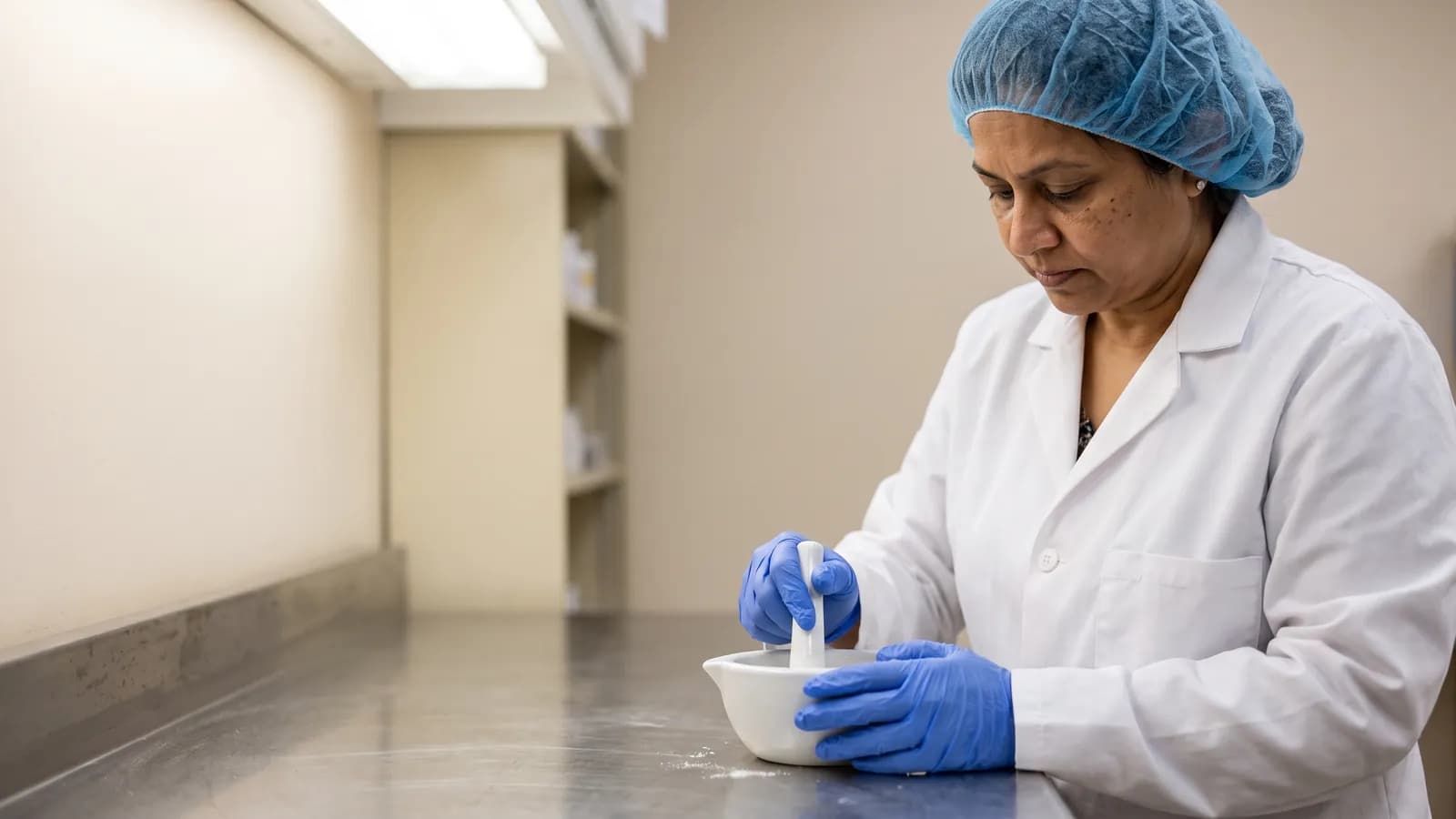
According to FDA, compounding generally means a licensed pharmacist or physician combines, mixes or alters drug ingredients to make a medication tailored to an individual patient's needs. FDA says compounded drugs can serve an important medical need for certain patients, but may also pose risks to patients. [1]
FDA states: "Compounded drugs are not FDA-approved. This means that FDA does not verify the safety, effectiveness or quality of compounded drugs before they are marketed." [2]
What compounding means
According to FDA, compounding most often takes place in pharmacies, although it can also happen in other settings. [2]
FDA's full definition of compounding also covers outsourcing facilities, where a person supervised by a licensed pharmacist combines, mixes or alters drug ingredients. [1]
FDA says compounded drugs are not FDA-approved, which means FDA does not review their safety, effectiveness or quality before they are marketed. By law, compounders do not need to prove to FDA that their products meet the same standards that drug manufacturers must meet. [1][3]
Why compounding exists
FDA says a drug may be compounded for a patient who cannot be treated with an FDA-approved medication, such as a patient allergic to a certain dye who needs a medication made without it, or a child or older adult who cannot swallow a tablet or capsule and needs a liquid. Hospitals, clinics and other health care facilities sometimes give patients compounded drugs when an FDA-approved drug is not medically appropriate for them. [2]
FDA says compounders may also prepare versions of a drug on FDA's drug shortages list if the compounded drug meets certain conditions in federal law. FDA says compounded drugs should only be used in patients whose medical needs cannot be met by an FDA-approved drug. [2]
Risks FDA describes
According to FDA, unnecessary use of compounded drugs may expose patients to potentially serious health risks. FDA says poor compounding practices can cause serious drug quality problems, such as contamination or a drug with too much or too little active ingredient, which can lead to serious patient injury and death. [2]
FDA says federal law on insanitary conditions applies wherever compounding happens, whether in a pharmacy, an outsourcing facility or a physician's office. [2]
We found no FDA source, among those reviewed for this page, showing that a compounded drug performs the same as an FDA-approved drug with the same active ingredient.
The two federal pathways: 503A and 503B
503A: pharmacies and physicians. Section 503A of the federal Food, Drug, and Cosmetic Act sets the conditions under which a compounded drug is exempt from the law's requirements for FDA approval, current good manufacturing practice (CGMP) and labeling with adequate directions for use. [4]
One condition of section 503A is that the drug must be compounded based on a valid prescription for an identified individual patient. Under section 503A, compounding is done by a licensed pharmacist in a state-licensed pharmacy or a federal facility, or by a licensed physician. Section 503A also allows a pharmacist or physician to compound limited quantities before a prescription arrives, based on a history of receiving valid prescriptions for that drug. [5]
Section 503A says a pharmacy may not regularly, or in inordinate amounts, compound drugs that are essentially copies of a commercially available drug product. Under section 503A, a drug with a change made for one patient that the prescriber determines makes a significant difference for that patient is not counted as a copy. [5]
Under section 503A, compounding does not include mixing or reconstituting a drug according to the directions in its approved labeling. [5]
Outsourcing facilities. FDA says section 503B, added in 2013 by the Drug Quality and Security Act, created a voluntary category of compounders called outsourcing facilities. [2][4]
Under federal law, an outsourcing facility is a facility at one location that compounds sterile drugs, has chosen to register with FDA as an outsourcing facility, and meets all of the requirements of section 503B. FDA says drugs made by an outsourcing facility can qualify for exemptions from FDA approval requirements and from labeling with adequate directions for use, but not from current good manufacturing practice (CGMP) requirements. [6]
Unlike 503A compounders, outsourcing facilities may supply compounded drugs either for a patient-specific prescription or on an order from a health care provider, such as a hospital, that is not for a named patient, for example for office stock. [4]
Under section 503B, an outsourcing facility is not required to be a licensed pharmacy. Section 503B says a drug compounded by an outsourcing facility must not be essentially a copy of one or more approved drugs. Section 503B does not count a drug as a copy of an approved drug when the approved drug is on FDA's drug shortage list at the time of compounding, distribution and dispensing. Section 503B also does not count a drug as a copy when a change produces a clinical difference for an individual patient, as determined by the prescriber. [7]
Federal law requires the label of a drug from an outsourcing facility to include the statement "This is a compounded drug." or a comparable statement that prominently identifies it as compounded. [7]
| Feature | 503A pharmacy compounding | 503B outsourcing facility |
|---|---|---|
| Law | Section 503A of the FD&C Act | Section 503B, added in 2013 by the Drug Quality and Security Act |
| Who makes it | A licensed pharmacist in a state-licensed pharmacy or federal facility, or a licensed physician | A facility that compounds sterile drugs and registers with FDA as an outsourcing facility |
| Patient orders | A valid prescription for an identified individual patient | Patient-specific prescriptions, or provider orders not for a named patient (such as office stock) |
| Copies | May not regularly or in inordinate amounts compound essentially copies of commercially available drugs | Must not be essentially a copy of an approved drug, with exceptions the law defines |
| CGMP | Not subject to CGMP requirements | Subject to CGMP requirements |
| Main oversight | State boards of pharmacy, day to day; FDA does surveillance and for-cause inspections | Primarily FDA, with inspections on a risk-based schedule |
| Label statement | Not yet checked by us | Required statement: "This is a compounded drug." or a comparable one |
| Premarket review | No FDA premarket review of safety, effectiveness or quality | No FDA premarket review of safety, effectiveness or quality |
Sources: [2][4][5][7]
Compounded drugs compared with generic drugs
FDA says a compounded drug is not the same as a generic drug: a generic drug is approved by FDA and must meet the requirements of section 505(j), including therapeutic equivalence to a brand-name drug, while a compounded drug is not approved. [2]
| Feature | Generic drug | Compounded drug |
|---|---|---|
| Legal basis | Approved by FDA under section 505(j) | Not approved by FDA |
| What is reviewed | Bioequivalence studies in an Abbreviated New Drug Application | No FDA premarket review of safety, effectiveness or quality |
| Equivalence | Must establish therapeutic equivalence to a brand-name drug | Compounders do not need to prove to FDA that products meet drug manufacturers' standards |
Sources: [1][2][8]
Who oversees compounding, and what standards apply
FDA says state boards of pharmacy generally have primary responsibility for day-to-day oversight of state-licensed pharmacies that are not registered with FDA as outsourcing facilities. FDA says it conducts surveillance and for-cause inspections of state-licensed pharmacies that are not registered as outsourcing facilities. [2]
FDA says outsourcing facilities registered under section 503B are primarily overseen by FDA and are inspected by FDA on a risk-based schedule. FDA says drugs compounded in outsourcing facilities must meet current good manufacturing practice (CGMP) requirements, while drugs compounded under section 503A by a licensed pharmacist or physician do not. [2]
FDA says people who buy compounded drugs online, including through online pharmacies and telehealth platforms, may not know which compounder made the drug or whether that compounder meets appropriate quality standards and is properly licensed and regulated. [2]
Compounding vs. off-label use
A compounded drug is a different category from off-label use: FDA says compounded drugs are not FDA-approved, while off-label use means using an FDA-approved drug for an unapproved use. [2][9]
Other federal rules that apply
Under federal law, prescription drug promotion by or for drug manufacturers, including compounders, must be truthful, non-misleading and accurate. FDA says biological products are not eligible for the compounding exemptions in sections 503A and 503B. [2]
Talk to a licensed clinician or pharmacist about whether a compounded medication is appropriate for you.
Related pages
- What Does FDA-Approved Mean?
- FDA Drug Approval Process Explained
- How We Grade Medical Evidence
- Is NAD+ IV Therapy FDA-Approved?
- Is Semaglutide FDA-Approved for Weight Loss?